Mathematik in
gesellschaftlicher Transformation
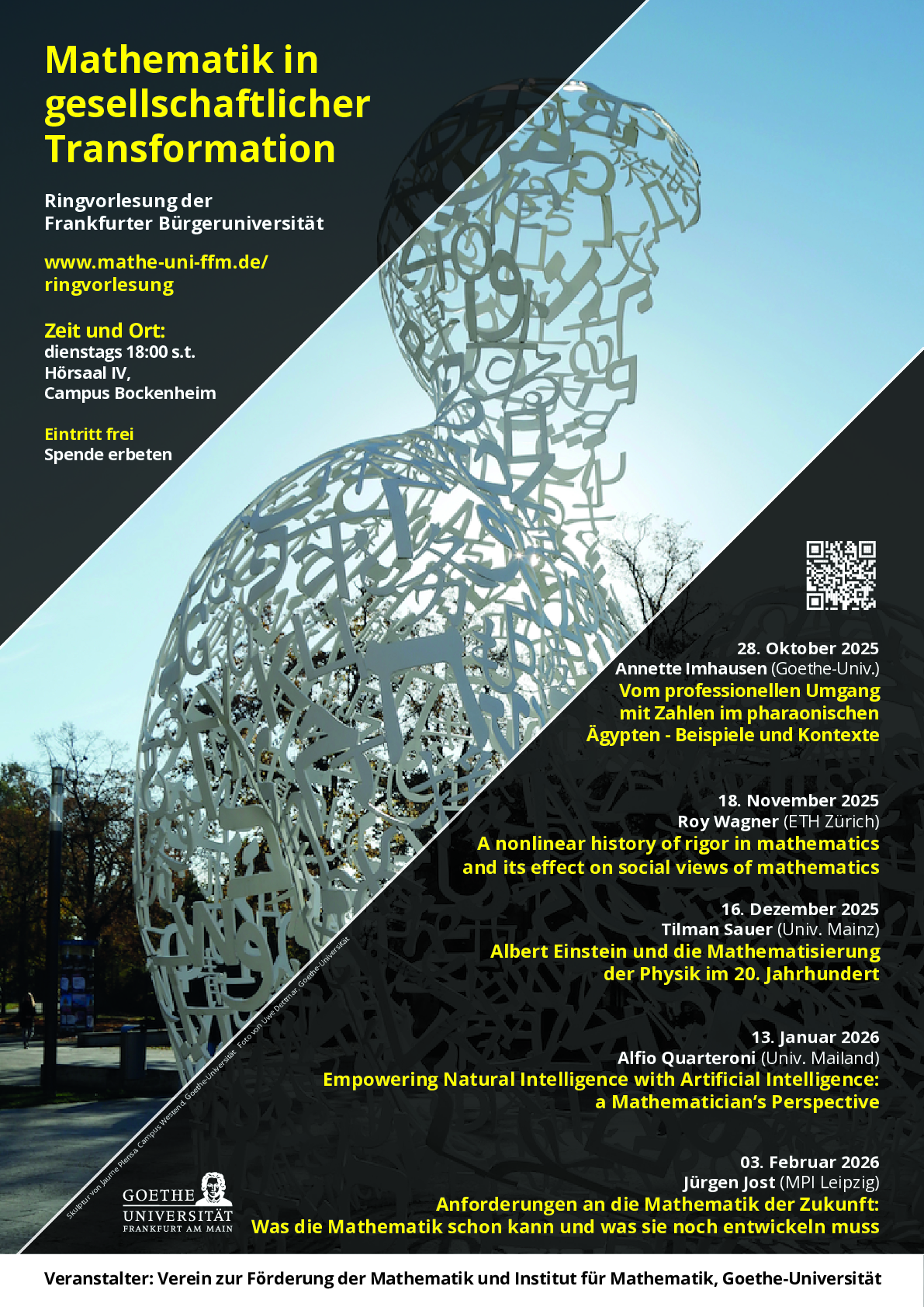
Die Vorträge werden in Präsenz durchgeführt, immer dienstags um 18:00 s.t. im öffentlich zugänglichen Hörsaal
Hörsaal IV der Goethe-Universität.
Gräfstrasse 52,
60486 Frankfurt
Zudem werden die Vorträge aufgezeichnet und können auf dem YouTube-Kanal des Fördervereins angesehen werden.
Die Veranstaltungen
28.10.2025 | Annette Imhausen (Goethe-Univ.)
Vom professionellen Umgang mit Zahlen im pharaonischen Ägypten – Beispiele und Kontexte
Ägypten und Mesopotamien gehören zu den Kulturen, aus denen die ältesten Quellen mathematischer Texte erhalten sind. In beiden Kulturen wurden Zahlen, metrologische Systeme und mathematische Techniken zur Kontrolle von Ressourcen entwickelt. In Ägypten diente die Mathematik, bzw. mathematische Verfahren, außerdem auch als Garantin der Gerechtigkeit (im Sinne der Maat, d.h. der ägyptischen richtigen Weltordnung). Der Vortrag gibt eine Übersicht über die Quellen des pharaonischen Ägyptens, anhand derer sich diese Entwicklungen nachvollziehen lassen.
18.11.2025 | Roy Wagner (ETH Zürich)
A nonlinear history of rigor in mathematics and its effect on social views of mathematics
In this talk, I will discuss standards of rigor in classical Greek mathematics, in some examples of Indian and/or Chinese mathematics, and in 18th-20th century European mathematics. I will try to emphasize the understanding of mathematics reflected by the different standards of rigor, the goals it served, and the social views of mathematics that it helped constitute.
16.12.2025 | Tilman Sauer (Univ. Mainz)
Albert Einstein und die Mathematisierung der Physik im 20. Jahrhundert
13.01.2026 | Alfio Quarteroni (Univ. Mailand)
Empowering Natural Intelligence with Artificial Intelligence: a Mathematician’s Perspective
Recent advances in artificial intelligence have led to remarkable achievements across a broad spectrum of applications. Despite these successes, persistent concerns remain regarding the accuracy, robustness, and interpretability of AI models, which are often criticized as opaque “black boxes.” Scientific Machine Learning (SciML) has emerged as a powerful alternative paradigm, combining data-driven techniques with models informed by physical laws, thereby creating a principled bridge between artificial intelligence and traditional scientific modeling. In this presentation, I will discuss the mathematical foundations of machine learning, highlighting their theoretical properties as well as their intrinsic limitations. I will then focus on Scientific Machine Learning, illustrating how incorporating prior physical knowledge of the underlying processes can significantly enhance the reliability, interpretability, and performance of numerical solvers. This paradigm plays a key role in the development of Digital Twins—high-fidelity numerical replicas of real-world systems—across a wide range of scientific and engineering applications. As a central case study, I will present recent advances in the numerical simulation of human cardiac function.
03.02.2026 | Jürgen Jost (MPI Leipzig)
Anforderungen an die Mathematik der Zukunft: Was die Mathematik schon kann und was sie noch entwickeln muss
Traditionell hat sich die Mathematik in inniger Verbindung mit der Physik entwickelt, und die beiden Wissenschaften sind eng verknüpft. Physikalische Vorgänge werden durch Differentialgleichungen in einem geometrischen Kontext beschrieben, und physikalische Theorien beruhen auf Symmetrieprinzipien. Zwar können auch viele biologische Strukturen und Prozesse mathematisch modelliert werden, aber vieles kann bisher noch nicht durchgängig mathematisch beschrieben und analysiert werden. Ich werde darlegen, inwiefern es eine allgemeine Eigenschaft komplexer Systeme ist, sich der Erfassung durch die für die Physik entwickelten mathematischen Theorien und Methoden zu entziehen. Eine neue Herausforderung erwächst der Mathematik nun allerdings durch die moderne Datenwissenschaft, nämlich Strukturen in großen und unübersichtlichen Daten zu finden. Ich werde erläutern, was die Mathematik hier schon bereit stellen kann und was noch geschaffen werden muss, auf dem Weg der Mathematik zu einer abstrakten Strukturwissenschaft.